How to Prevent Chatter by Balancing Turret Overhang on a CNC Slant Bed Turning Center
A CNC Slant Bed Turning Center is engineered for rigidity and precision, but even the most stable machine can suffer from poor surface finish due to vibration, commonly known as chatter. This issue often originates not from the machine's core structure but from an imbalanced tooling setup, specifically the relationship between tool projection from the turret, holder mass, and the direction of cutting forces. Understanding how these elements interact is the first step toward achieving flawless finishes and maximizing the performance of your equipment.
These machines are fundamental assets for shops that require high-accuracy turning, from producing complex mold components to small-batch manufacturing of diverse parts. Their angled bed design offers superior chip evacuation and operator access compared to flat-bed lathes. However, this configuration also influences the physics of the cut. By systematically diagnosing the source of vibration, you can make targeted adjustments that restore precision without resorting to costly trial-and-error.
Diagnosing Chatter Triggers: A Systematic Check
When chatter marks appear on a workpiece, the immediate cause is a tool vibrating at a harmonic frequency. This vibration is not random; it's a direct result of the system's lack of rigidity at the cutting point. The tool, holder, and turret act as a single assembly, and any instability is magnified during the cut. Before blaming the machine itself, use this diagnostic process to isolate the tooling issue. Check these factors in order, as the simplest fixes are often the most effective.
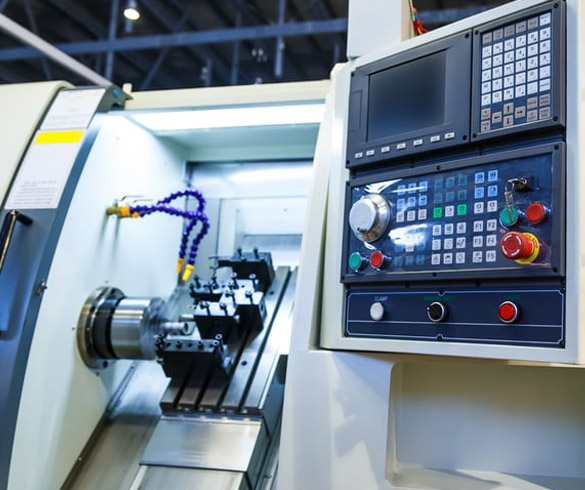
- 1. Check Tool Projection (Overhang): This is the most common cause of chatter. The further a tool projects from the turret, the more it acts like a lever, amplifying any cutting force into vibration.
- Symptom: High-frequency chatter marks, especially on heavy or interrupted cuts. The problem worsens as the tool wears.
- Action: Reduce the overhang to the absolute minimum required to clear the workpiece and chuck. If a standard tool is too long, consider a shorter shank tool or a different holder style. For every unit of length you reduce overhang, you increase rigidity exponentially.
- When it Doesn't Apply: Internal boring operations inherently require long overhang. In these cases, focus on the other factors or use specialized anti-vibration boring bars.
- 2. Evaluate Holder and Tool Mass: Heavier tooling assemblies have more inertia and are harder to excite into vibration. A lightweight, flimsy holder is more susceptible to chatter than a robust, heavy-duty one.
- Symptom: Vibration occurs even with minimal overhang, particularly when using smaller-shank tools.
- Action: Whenever possible, use the largest, most rigid tool holder that will fit the application. Choose solid carbide or heavy metal tools over high-speed steel for their increased density and stiffness. Ensure the holder is properly seated and clamped in the turret with maximum surface contact.
- When it Doesn't Apply: High-speed operations with rapid direction changes may favor lighter tooling to reduce turret indexing stress, but this is a trade-off against rigidity.
- 3. Analyze Cutting Force Direction: The orientation of the tool relative to the workpiece dictates where the cutting force is applied. Forces directed away from the turret's center of mass are more likely to induce twisting (torsional) vibration.
- Symptom: Chatter appears during specific operations, like facing near the centerline or profiling certain contours, but not during others like simple turning.
- Action: Adjust your toolpath or tool selection to direct the primary cutting force back into the most rigid part of the machine structure. For example, use a tool with a different lead angle or change from a negative to a positive rake insert to reduce tool pressure.
- When it Doesn't Apply: Part geometry may constrain your choice of tool angles and paths. In such cases, mitigating the issue through speed and feed adjustments becomes the primary solution.
Core Machine Characteristics That Guarantee Stability
While tooling setup is a critical variable you can control, the inherent stability of your CNC Slant Bed Turning Center provides the foundation for chatter-free machining. A machine built for rigidity can tolerate less-than-perfect setups far better than a lightly constructed one. At MAKCNC, our machines are built from the ground up to absorb and dampen vibration. Our ISO9001:2015 certified facility focuses on creating a stable platform through superior materials and construction methods.
Key structural elements include:
| Component | Material & Process | Benefit to Stability |
|---|---|---|
| Machine Body | High-strength cast iron (resin sand castings) with aging treatment. | Provides excellent vibration damping. The aging process relieves internal stresses, ensuring the machine frame maintains its geometric accuracy and rigidity over years of use. |
| Core Drive System | High-precision lead screws and guide rails from reputable Taiwan or German brands. | Minimizes backlash and ensures smooth, precise axis movement. This prevents the micro-movements that can initiate and sustain chatter during contouring. |
| System Integration | Advanced controls with intelligent feed-forward and quadrant glitch compensation. | Proactively manages tool motion to avoid common surface finish flaws like over-cutting, quadrant marks, and vibration patterns, especially in high-precision mold machining. |
Matching Machine Capabilities to Your Production Needs
Selecting the right machine configuration is essential for maximizing efficiency. Our CNC machines are designed with the flexibility needed for today's manufacturing challenges. Whether you're engaged in high-volume production or high-mix, low-volume work, the right features can significantly reduce setup times and improve part quality.
Consider these scenarios:
- For Multi-Variety, Small-Batch Production: The ability to complete a complex part in a single setup is a major advantage. Our machines are capable of multi-face machining, which reduces handling, eliminates re-fixturing errors, and shortens overall cycle times. This is ideal for job shops that need to switch between different parts quickly.
- For High-Precision Mold Industry: The surface finish is non-negotiable. The integration of intelligent compensation technologies directly addresses and solves common machining issues like "over-cut marks" and "vibration marks," delivering a finish that requires less manual polishing. This is a core competency of a well-designed professional cnc machining center solution.
Your Partner for Reliable CNC Solutions
Since our establishment in 2016, MAKCNC has focused on building durable and precise CNC machinery. We understand that purchasing a machine tool is a significant investment. That's why we support our partners with transparent business terms and responsive service. We have no rigid minimum order quantity; you can procure a single machine to start. For businesses looking to scale, we offer improved commercial terms on pricing, delivery, and service for bulk purchases.
Our commitment extends beyond the sale. A standard 12-month warranty after final acceptance is included with every machine, and we provide lifetime paid service. For specific tenders or projects with higher requirements, extended warranties of up to three years can be arranged. Our established after-sales network is built for speed, with a commitment to respond to service inquiries within 8 hours and have a technician on-site within 48 hours to resolve any issues.
Frequently Asked Questions for B2B Buyers
What is the typical lead time for a new machine?
Our standard lead time ranges from one to six months, depending on the machine's complexity, current production schedules, and any customization required. We maintain a stock of sample machines to facilitate faster demonstrations and, in some cases, quicker delivery.
Is there a minimum order quantity (MOQ)?
We have no strict MOQ. You can purchase a single unit. However, placing a bulk order for multiple machines often allows us to offer more favorable business terms regarding price, delivery priority, or after-sales service packages.
What does your standard warranty cover?
The standard warranty covers the entire machine for 12 months after on-site acceptance and commissioning. It covers defects in materials and workmanship. We also offer lifetime access to paid technical support and spare parts to ensure your machine remains productive for many years.
How is the machine's long-term accuracy ensured?
We ensure long-term precision through two key strategies. First, the machine body is made from high-strength, stress-relieved cast iron, which provides a stable, non-warping foundation. Second, we use only high-grade motion components, such as ball screws and linear guides from leading German or Taiwanese manufacturers, ensuring lasting performance.
If you are looking for a reliable CNC machine supplier, please submit your drawings or contact us for a detailed quote based on your specific machining requirements.