
4 Axis CNC Machine Rotary Axis Programming Guide
What Is a 4-Axis CNC Machine?
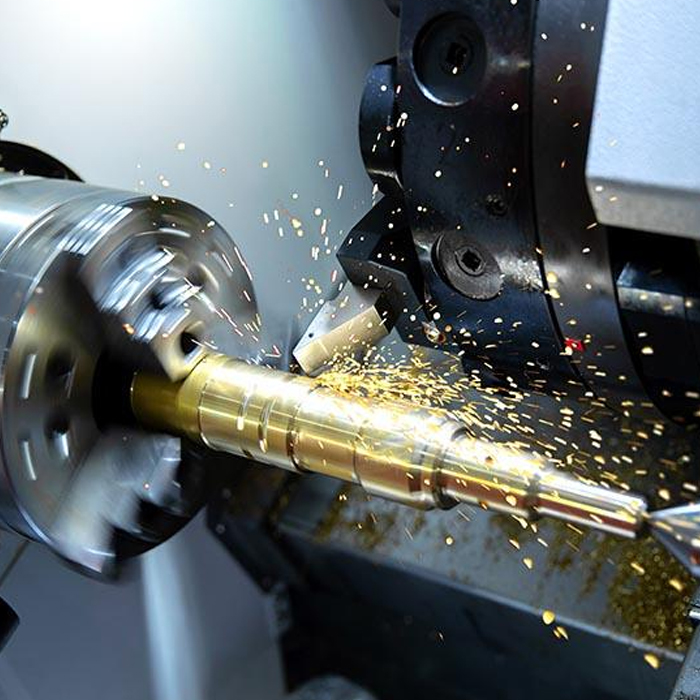
A 4-axis CNC machine adds a rotational axis to the standard three linear axes (X, Y, Z). This fourth axis—commonly called the A-axis—is a rotary device that either spins the workpiece or tilts the cutting head. In a typical vertical machining center, a rotary table mounted on the bed rotates the part around the X-axis. The machine’s controller precisely indexes the rotation in angular degrees, allowing cuts on multiple faces without manual repositioning.
Compared to a standard 3-axis mill, a 4-axis setup eliminates the need for multiple fixtures and setups. Instead of clamping a part five separate times to machine all sides, an operator simply loads it once. The rotary axis indexes the part to expose each face to the spindle. This indexed machining approach cuts production time, reduces tolerance stack-up, and enables more complex geometries. While the fourth axis usually rotates around X (A-axis), some configurations use a tilting spindle head (B-axis) or a trunnion table. At MAKCNC, we equip many of our vertical machining centers—like the vertical cnc machining center MV1380—with optional 4-axis rotary tables to suit customer needs.
Types of 4-Axis CNC Machines
The 4-axis CNC machine comes in several configurations, each solving a different manufacturing challenge.
1. Vertical machining centers with an add-on rotary table. This is the most common arrangement. A standard 3-axis VMC gets a rotary axis (A-axis) installed on its table. The workpiece is fixtured on the rotary table, which indexes in programmed increments. Because the spindle remains vertical, it’s well-suited for drilling, tapping, and contouring on multiple faces of a part. MAKCNC’s horizontal cnc machining center line can also be configured with a built-in B-axis rotary pallet, adding 4-axis capability in a horizontal setup.
2. 4-axis horizontal machining centers. These machines integrate a B-axis rotary table as a native feature. The workpiece mounts on the rotary table, which faces the horizontal spindle. The B-axis rotation, combined with X, Y, Z moves, efficiently handles prismatic parts that need machining on four sides.
3. Trunnion tables and tilting rotary devices. For more flexibility, a trunnion table provides both tilt and rotation, effectively mimicking a 5-axis setup in some respects, though the tilt axis is often fixed. These are popular in mold and die shops.
4. Dedicated 4-axis milling machines. Built from the ground up with a rotary axis, these machines feature extremely stiff axis drives and high-precision rotary encoders. They are chosen for production environments where complex contours are machined daily.
While each type varies in complexity, the core idea stays the same: add rotational control to cut parts with fewer setups.
Features of 4-Axis CNC Machines
A 4-axis CNC machine brings distinct advantages over 3-axis equipment, and understanding these features helps buyers evaluate if the investment is right for their shop.
Reduced setups, higher accuracy. With 3-axis milling, machining a part with through-holes on four sides typically requires four separate fixtures and alignments. Each repositioning introduces a potential 0.02–0.05 mm error. A 4-axis rotary table indexes the part precisely to the programmed angle, so all four sides can be machined in one clamping. This directly improves positional accuracy and often slashes setup time by more than 50%.
Access to undercuts and angled features. Because the workpiece can be rotated to present an angled surface perpendicular to the spindle, features such as helical slots, angled holes, and compound contours become machinable without special 3D toolpaths. The rotary axis