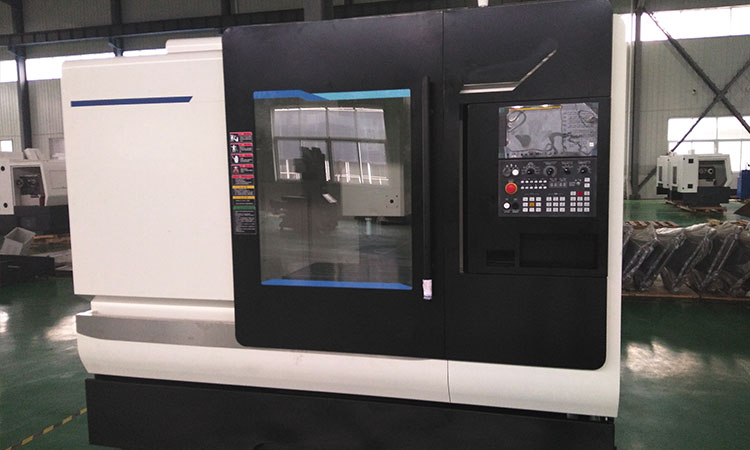
How to Eliminate Surface Defects from Chip Recutting on a Metal Turning Slant Bed CNC Lathe
A high quality and durable cnc lathe, especially a Metal Turning Slant Bed CNC Lathe, is acquired for its precision and efficiency. Yet, operators often face a persistent issue that undermines performance: poor surface finish caused by chip recutting. When chips are not effectively evacuated from the cutting zone, they can become trapped between the tool and the workpiece, leading to scratches, dimensional inaccuracies, and accelerated tool wear. This article provides a systematic approach to diagnosing and resolving chip recutting issues, ensuring your machine delivers the quality it was built for.
At MAKCNC, we build our machines to address these exact challenges from the ground up. The inherent design of a slant bed lathe uses gravity to assist with chip removal, but optimal performance requires a holistic understanding of the cutting process, coolant delivery, and machine configuration. By controlling how chips form and where they go, you can protect both your workpiece and your tooling investment.
Why Chip Control Is Critical for Turning Operations
Ineffective chip management is more than just a housekeeping issue; it directly impacts profitability. When chips are recut, they cause a cascade of problems that increase operational costs and reduce part quality. The primary consequence is a compromised surface finish. Trapped chips score the workpiece, creating marks that may require secondary finishing operations or cause the part to be scrapped entirely. This is particularly unacceptable in industries like mold and die manufacturing, where surface integrity is paramount.
Furthermore, recutting chips places unpredictable loads on the cutting insert, leading to premature edge wear, chipping, or catastrophic tool failure. This not only increases tooling costs but also introduces unscheduled machine downtime for tool changes. A well-managed chip flow leads to predictable tool life, allowing for more reliable production planning. The stability of our machine bodies, constructed from high-strength cast iron and subjected to aging treatment, provides the rigidity needed for consistent chip formation, which is the first step in effective chip control.
A Diagnostic Guide to Chip Recutting Problems
Troubleshooting chip recutting requires a methodical approach. Instead of randomly adjusting parameters, use a diagnostic framework that starts with the easiest and most likely causes. The symptoms you observe on the workpiece and the tool provide clear clues to the root of the problem. Use the following guide to identify and correct issues systematically.
| Symptom | What to Check First | Potential Cause | Recommended Action |
|---|---|---|---|
| Long, stringy chips ("bird's nests") getting wrapped around the chuck or tool. | Chip Shape & Size | Feed rate is too low or depth of cut is too small for the insert's chip breaker geometry. Incorrect insert style for the material. | Increase the feed rate and/or depth of cut within safe limits. Select an insert with a more aggressive chip breaker designed for finishing or the specific material being cut. |
| Fine, intermittent scratches on the finished surface. | Coolant Flow & Direction | Coolant pressure is too low to flush chips away. Nozzles are poorly aimed and not reaching the cutting edge. | Increase coolant pump pressure. Adjust nozzles to target the point of contact between the insert and workpiece, creating a powerful flushing action. Ensure coolant concentration is correct. |
| Chips accumulating in the machine bed, not moving to the conveyor. | Chip Conveyor & Machine Design | The chip conveyor type is mismatched for the chip type (e.g., a magnetic conveyor used for non-ferrous materials). Slant bed angle is insufficient for the sticky material. | Ensure the correct conveyor type is installed. For stringy chips, a hinged-belt conveyor is often better than a scraper type. Use high-pressure coolant to assist chip movement toward the conveyor. |
| Sudden tool chipping or breakage without changing cutting parameters. | Workpiece & Tool Holder | Chips are packing into tight corners or internal features and getting wedged against the tool. The tool holder may be deflecting under load. | Modify the toolpath to include pecking cycles or periodic retraction to break chips and clear the cutting zone. Verify tool and holder rigidity. |
Machine Features That Ensure Effective Chip Evacuation
Preventing chip recutting begins with the machine's fundamental design. A well-engineered Metal Turning Slant Bed CNC Lathe incorporates features specifically intended to manage chips from the moment they are created. Our machines are built with high-strength resin sand cast iron, which undergoes an aging process to ensure long-term rigidity and vibration damping. This stability is the foundation for creating consistent, manageable chips.
Key components contribute directly to this goal:
- Core Drive Components: We utilize high-precision ball screws and linear guides from established brands in Taiwan and Germany. Their smooth, precise motion eliminates micro-vibrations and chatter that can lead to inconsistent chip formation.
- Advanced CNC System Integration: For high-precision applications like mold making, our systems incorporate intelligent feedforward control and quadrant glitch compensation. These technologies proactively manage toolpath dynamics to prevent issues like over-cutting, quadrant marks, and chatter marks—all of which disrupt ideal chip formation.
- Multi-Axis Capability: The ability to complete multi-sided machining in a single clamping, a feature valuable for small-batch production, also reduces chip-related problems. By reorienting the part, gravity can assist in clearing chips from different features without manual intervention.
Buyer's Checklist: Choosing the Right Chip Conveyor
The chip conveyor is not an accessory; it is an integral part of the chip management system. Selecting the wrong type can lead to constant production stoppages. Use this checklist when specifying a conveyor for your lathe:
- What material are you cutting?
- Ferrous (Steel, Iron): Hinge-belt, scraper, or magnetic conveyors are all viable. Magnetic conveyors work well for small, broken chips but are ineffective for large or stringy ones.
- Non-Ferrous (Aluminum, Brass): Do NOT use a magnetic conveyor. Hinge-belt or scraper types are standard choices. Aluminum chips can be sticky, so a conveyor with good coolant flush-down is essential.
- What is the typical chip shape?
- Small, Broken Chips: Scraper or magnetic conveyors are efficient and cost-effective.
- Long, Stringy, or Bushy Chips: A hinge-belt conveyor is the most reliable option. Its design is less prone to jamming from large chip bundles.
- What is the volume of material removal?
- High-Volume Roughing: A wider, robust hinge-belt conveyor is necessary to handle the heavy chip load without interruption.
- Low-Volume Finishing: A standard scraper-type conveyor may be sufficient.
MAKCNC: Your Supplier for Reliable CNC Turning Solutions
Established in 2016, MAKCNC operates an ISO 9001:2015-certified facility with multiple production lines dedicated to building dependable CNC machinery. We understand that uptime and quality are critical, which is why our designs focus on solving common production challenges like chip management. We maintain a stock of sample machines, allowing us to offer lead times typically ranging from 1 to 6 months.
We believe in flexible partnerships. There is no rigid minimum order quantity; you can procure a single machine. However, purchasing in volume allows for more favorable commercial terms regarding price, delivery, and after-sales support. Our standard warranty covers the entire machine for 12 months after acceptance, with lifetime paid service available. Our mature service network is committed to an 8-hour response time and 48-hour on-site arrival for troubleshooting, ensuring your production remains on track. For a professional cnc machining center solution, look no further than our expert team.
Frequently Asked Questions
What is the ideal chip shape for turning?
For most steel and alloy turning operations, the ideal chip is a tightly curled "6" or "9" shape. These shapes indicate that the chip breaker on the insert is functioning correctly. They are brittle, break easily, and are readily flushed away by coolant, posing minimal risk of recutting or wrapping.
Can I order a single machine from MAKCNC?
Yes. We have no hard minimum order quantity, and single-unit purchases are welcome. We also offer improved commercial terms for bulk orders, which can provide advantages in pricing, delivery scheduling, or service packages.
What kind of warranty and support can I expect?
Our standard warranty is for 12 months after final machine acceptance. We also offer lifetime paid service options. Our after-sales support network commits to responding to service requests within 8 hours and having a technician on-site to address faults within 48 hours.
If you are struggling with surface finish consistency or excessive tool wear, our team can help. Contact us to discuss your specific turning application and learn how our machines are designed to provide a reliable solution.