What is a Large Horizontal CNC Machining Center?
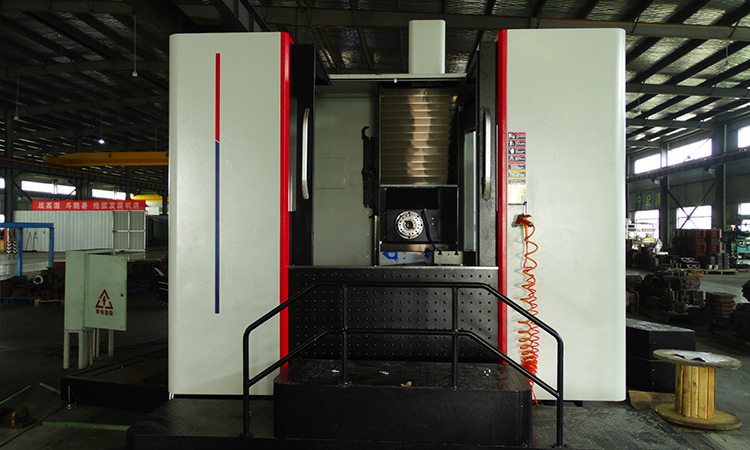
A Large Horizontal CNC Machining Center, often abbreviated as an HMC, is a sophisticated machine tool designed for high-precision milling, drilling, tapping, and boring of sizable or heavy workpieces. Its defining characteristic is the horizontally oriented spindle, which contrasts with the vertical spindle of a VMC. This design allows gravity to assist in chip evacuation, preventing chip recutting and improving surface finish, especially in deep pockets and cavities. Built for demanding industrial applications, these machines feature a robust structure, typically made from high-strength cast iron with aging treatment to ensure long-term rigidity and accuracy. Core components like ball screws and linear guideways are sourced from premium manufacturers in regions like Germany and Taiwan to deliver consistent performance. This type of machine is essential for manufacturers who need to machine multiple sides of a large part in a single setup, maximizing both efficiency and precision.
Types of Large Horizontal Machining Centers
Large horizontal machining centers can be categorized based on their configuration, primarily concerning their pallet changing systems and axis capabilities. The choice of type directly impacts a workshop's productivity, flexibility, and level of automation. A common classification is by the pallet system. A single-pallet HMC is the most basic configuration, suitable for job shops or low-volume production where changeover time is less critical. A twin-pallet HMC, featuring an Automatic Pallet Changer (APC), is far more common in production environments. While the machine is cutting a part on one pallet, an operator can safely load and unload the next workpiece on the other, drastically reducing non-productive spindle downtime. For higher volume or lights-out manufacturing, multi-pallet systems (linear or rotary) can integrate several pallets, allowing for extended automated runs. Another classification is by the number of axes. A standard HMC offers 4-axis machining (X, Y, Z, and a rotary B-axis table), which is sufficient for machining four sides of a cubic part. A 5-axis HMC adds a tilting A-axis or C-axis, enabling complex contouring and machining of five sides of a part in a single clamping.
Key Features of High-Performance HMCs
The performance of a large HMC is not determined by a single component but by the synergy of its entire system. Several key features are engineered to deliver the accuracy, power, and reliability required for challenging machining tasks. These features work together to solve common machining problems and ensure consistent output over the machine's lifespan.
- Structural Rigidity: The foundation of any precision machine is its frame. Our machine bodies are constructed from high-strength cast iron, such as resin sand castings, which are subjected to an aging treatment. This process relieves internal stresses in the metal, preventing deformation over time and maintaining the machine's geometric accuracy and rigidity under heavy cutting loads.
- Precision Drive Components: The accuracy of movement is dictated by the quality of the drive system. We utilize high-precision ball screws and linear guideways from established Taiwanese or German brands. These components ensure smooth, backlash-free motion and high positioning repeatability, which are essential for holding tight tolerances.
- Advanced Control System Intelligence: To combat common defects in high-speed and high-precision applications, particularly in the mold industry, our systems integrate advanced control technologies. Features like intelligent feedforward and quadrant glitch compensation actively prevent issues such as over-cutting at corners, visible marks at axis-reversal points (quadrant marks), and chatter marks, resulting in a superior surface finish.
- Multi-Face Machining Capability: The inherent design of an HMC with a rotary B-axis allows for the machining of multiple faces of a workpiece in a single setup. This "one and done" capability minimizes part handling, reduces the chance of operator error from re-fixturing, and improves overall part accuracy by eliminating tolerance stacking.
Common Applications for Large HMCs
The unique capabilities of a Large Horizontal CNC Machining Center make it the preferred solution for specific industries and applications where size, weight, and complexity are primary challenges. Its robust construction is ideal for heavy material removal rates in tough alloys, while its configuration lends itself to efficient production of box-type or cubic parts. Key industries include aerospace, where large structural components and engine parts are machined from titanium and aluminum. In the automotive sector, HMCs are the standard for machining engine blocks, cylinder heads, and transmission housings. The energy industry relies on them for producing large valve bodies, turbine components, and pump housings. Furthermore, they are extensively used in the manufacturing of large molds and dies, as well as in the production of components for heavy machinery, where both size and precision are paramount for performance and safety.
Analyzing the Price and Total Cost of Ownership
The initial purchase price of a Large Horizontal CNC Machining Center is a significant capital investment, but it represents only a fraction of the machine's total cost over its operational life. A thorough evaluation requires a Five-Year Total Cost of Ownership (TCO) model, which provides a more accurate picture of the machine's financial impact. This approach helps you determine when the investment truly pays off. Below is a breakdown of the key cost components to consider.
| Cost Component | Description | Cost Type |
|---|---|---|
| Machine Purchase Price | The initial acquisition cost, including base machine, control, and any selected options. | Confirmed (Quote-Based) |
| Foundation & Installation | Cost of preparing a suitable concrete foundation to support the machine's weight and dampen vibration, plus rigging and commissioning fees. | Estimated (Requires Site Survey) |
| Tooling & Workholding | Investment in tool holders, cutting tools, and fixtures (e.g., tombstones) needed for your specific parts. | Variable (Application-Dependent) |
| Energy Consumption | Electricity costs for the spindle motor, drives, coolant pumps, and hydraulics over five years of operation. | Estimated (Based on Usage) |
| Labor & Maintenance | Operator wages, training costs, and expenses for preventive maintenance, spare parts, and service calls. | Estimated (Based on Labor Rates) |
| Throughput Gains (Revenue) | The financial benefit from increased output, reduced cycle times, and the ability to take on larger, more profitable work. This is a positive value that offsets costs. | Estimated (Business-Dependent) |
An HMC pays off when the throughput gains and efficiency improvements outweigh the total cost of ownership. This often occurs in high-volume production or when machining complex, high-value parts where reducing setups and cycle time creates a strong competitive advantage.
User Guide for Maximizing HMC Uptime and Performance
Proper planning and operation are essential for getting the most out of your investment in a large HMC. Before installation and during operation, several factors should be addressed to ensure smooth integration and sustained productivity. Using a checklist can help prevent common mistakes and ensure you are prepared for the machine's arrival and long-term use. This also includes understanding the after-sales support structure, which is vital for minimizing downtime. For example, a mature service network might promise an 8-hour response time and 48-hour on-site arrival for troubleshooting, which should be factored into your decision.
Pre-Purchase & Installation Checklist:
- Floor Space and Foundation: Have you confirmed that your facility has adequate square footage and floor depth for the machine's footprint and a proper foundation?
- Power and Air Supply: Are the required electrical service and compressed air lines available at the installation site?
- Chip Management Strategy: Have you planned for a chip conveyor and bin system appropriate for your material type and volume?
- Workholding and Tooling Plan: Have you budgeted for and identified the necessary tombstone fixtures, vises, and cutting tools for your initial projects?
- Operator Training: Is a training plan in place for your operators and maintenance staff on the new machine's control and systems?
- Service and Support Agreement: Have you clarified the terms of the warranty, response times for service, and availability of spare parts?
Your Trusted Large Horizontal CNC Machining Center Supplier
Since our establishment in 2016, MAKCNC has been dedicated to providing high-performance professional cnc machining center solution. Our ISO9001:2015 certified facilities operate multiple production lines, and we maintain an inventory of sample machines to facilitate client evaluation. We understand that every production need is different, which is why we have no rigid minimum order quantity; you can procure a single machine to meet your immediate needs. However, we also offer improved commercial terms on pricing, delivery, and after-sales service for bulk purchases. Our standard warranty covers the machine for 12 months after acceptance, and we provide lifetime paid service to ensure your investment remains productive for years to come. Our commitment is to build reliable machines that deliver lasting value and precision.
Frequently Asked Questions about Large HMCs
What is the typical lead time for a large HMC?
Lead times can vary based on machine configuration and production schedules. At MAKCNC, our typical delivery window is between one to six months from the time of order confirmation.
What kind of warranty and after-sales support is provided?
We provide a standard 12-month warranty on the entire machine after final acceptance. For projects with specific requirements, such as government tenders, we can offer extended warranties of up to three years. Our after-sales service network is committed to an 8-hour response time and 48-hour on-site arrival to address any issues. Lifetime paid service is also available.
Is there a minimum order quantity?
No, there is no strict minimum order quantity. We support the purchase of a single unit. However, placing a bulk order for multiple machines may provide access to better commercial terms regarding price, lead time, or service packages.
How does a horizontal spindle help with chip management?
In a horizontal machine, the spindle is parallel to the floor. As the tool cuts the workpiece, chips fall down and away from the cutting zone due to gravity. They are then flushed away by coolant and removed by a chip conveyor. This prevents chips from accumulating, being recut, and damaging the surface finish or breaking tools, which can be a common problem in deep pockets on a vertical machine.
If you are looking for a Large Horizontal CNC Machining Center supplier, please feel free to contact us for the latest product quotation.