How to Choose a Precision Horizontal CNC Machining Center for Tight Tolerance Parts
A Precision Horizontal CNC Machining Center is a machine tool with a horizontally oriented spindle, designed to remove material from multiple faces of a workpiece without repositioning it manually. This layout matters more than most buyers realize at the shortlisting stage. The spindle orientation changes how chips fall, how heat distributes through the casting, and how many setups a gearbox housing or valve body actually needs before it ships. If you're comparing quotes from three or four suppliers right now, the decision usually comes down to one question: does the tolerance requirement on your part justify the higher cost of a horizontal platform over a vertical one?
What Is a Precision Horizontal CNC Machining Center
By definition, a horizontal machining center (HMC) mounts its spindle parallel to the work table, feeding tools into the part from the side rather than from above. Most HMC platforms pair this spindle orientation with a rotary pallet system, letting the machine index the workpiece 90 or 180 degrees between operations. This means a part with four machined faces can often be completed in one clamping instead of four. For mold makers and gearbox manufacturers, that single fact changes both cycle time and repeatability, because every re-clamp introduces a small but real risk of positional error.
Types of Precision Horizontal CNC Machining Centers
Not every HMC is built the same way, and the differences affect what kind of work each type handles well.
- Fixed-column HMC — the column stays stationary while the table and pallet move; common for mid-size housings and brackets.
- Traveling-column HMC — the column moves along the X-axis, suited to longer or heavier parts that would be awkward to shift on a table.
- Multi-pallet HMC with automatic pallet changer — built for lights-out or high-mix production, where one operator loads pallets while the spindle keeps cutting on another.
Buyers producing small batches of many different parts usually lean toward multi-pallet configurations, since setup time — not spindle time — is what eats their schedule.
Features of a Precision Horizontal CNC Machining Center
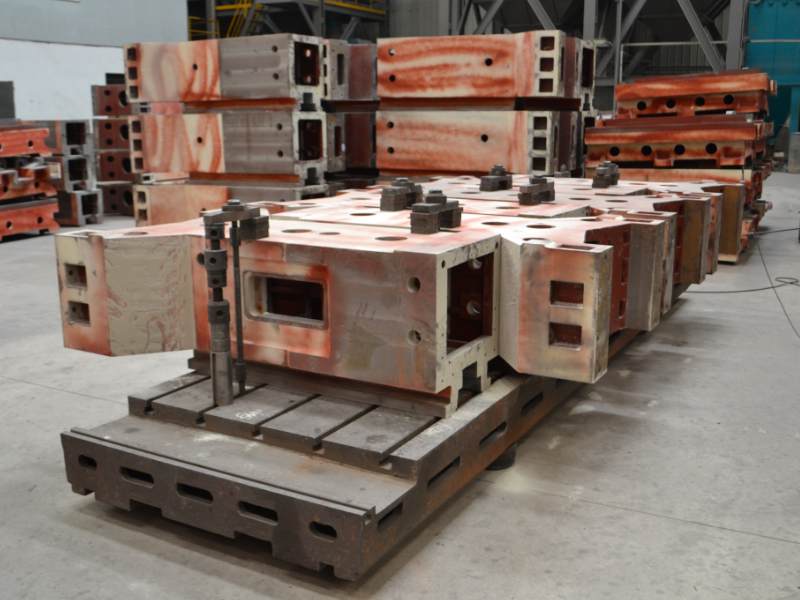
The frame is typically cast from high-strength iron, often resin sand casting, then aged through stress-relief treatment so the structure holds its geometry after years of thermal cycling. Core motion components — ball screws and linear guides — are commonly sourced from Taiwanese or German brands, chosen for their sustained positioning accuracy under load. On the control side, advanced systems now integrate intelligent feed-forward compensation and quadrant-transition correction, which directly reduces the tool marks, quadrant glitches, and chatter lines that plague mold and die work. For shops running many small-batch jobs, the ability to complete multi-face machining in a single clamping is arguably the most valuable feature on the list, since it removes repeat fixturing error entirely.
Comparing Thermal Stability, Accuracy, Pallet Repeatability, and Spindle Torque
This is where the real decision gets made. Spec sheets look similar across brands until you line them up against your actual part tolerance and production volume. Use this comparison logic before you shortlist any machine.
| Factor | Why It Matters | Choose Horizontal When | Choose Vertical When |
|---|---|---|---|
| HMC thermal stability | Heat from the spindle and motors distorts axis alignment over long shifts | Running 8+ hour unattended cycles on cast housings | Short-run jobs where the machine cools between parts |
| Positioning accuracy | Determines whether bore-to-bore distances hold spec across a gearbox casing | Multi-bore parts need sub-0.01mm repeatability across faces | Single-face plates or simple 2.5D parts |
| CNC pallet size / repeatability | Governs how consistently the part returns to the same reference after indexing | Parts need 3 or 4 faces machined with no re-clamping | Parts only need top-face access |
| Horizontal CNC spindle torque | Affects heavy roughing on cast iron or steel forgings | Deep pocket roughing, heavy interrupted cuts | Light finishing, small aluminum parts |
Decision rule: if your part needs more than one face machined to a tolerance tighter than what a single vertical setup can hold, and your production runs long unattended shifts, a horizontal platform earns back its added cost through reduced re-clamping error and better thermal control. If your parts are mostly flat, single-face, or low-volume prototypes, a vertical machining center is usually the more economical choice — see our vertical CNC machining center MV1380 for that scenario.
Precision Horizontal CNC Machining Center Applications
These machines are the standard choice for gearbox housings, engine blocks, hydraulic manifolds, and mold bases that require accuracy across multiple planes. Mold and die shops rely on the multi-face capability to hold parting-line tolerances without breaking reference between operations. Automotive and off-highway component makers use HMCs for high-mix, low-to-mid volume production where pallet changers keep spindle utilization high. For gearbox parts specifically, the accuracy demand is typically tied to bore concentricity and center-distance tolerance between mating gears — this is why HMC accuracy, not just spindle speed, becomes the deciding spec during evaluation.
Precision Horizontal CNC Machining Center Price
Pricing varies with several concrete factors, not brand alone:
- Pallet configuration — single-pallet units cost less than automatic pallet changer systems with 4+ stations.
- Spindle torque and speed range — higher-torque spindles for heavy roughing carry a price premium.
- Travel size (X/Y/Z) — larger work envelopes increase both casting weight and cost.
- Control system and compensation package — feed-forward and quadrant compensation options add cost but reduce scrap on mold work.
- Order volume — there's no hard minimum order quantity; a single unit can be purchased, but batch orders typically unlock better pricing, lead time, or after-sales terms.
Lead times generally run 1 to 6 months depending on configuration and whether the unit is built from stock or customized. Buyers with tight production schedules should ask suppliers directly about current sample machine availability before finalizing specs.
Precision Horizontal CNC Machining Center User Guide
Before commissioning, verify foundation flatness and ambient temperature control — thermal drift is the single biggest cause of accuracy complaints in the first 90 days of operation. Run a warm-up cycle of 15-20 minutes before precision cuts, particularly on the first shift of the day. Confirm pallet clamping pressure matches the fixture weight; under-clamped pallets are a common cause of repeatability drift after indexing. Schedule ball screw and guide lubrication per the maintenance manual, and log spindle thermal growth weekly during the first month to establish a compensation baseline. For multi-face parts, always machine the datum face first and reference all subsequent operations from it, rather than re-establishing zero on each face.
Common Mistakes When Selecting an HMC
- Choosing spindle speed over torque for heavy roughing applications — this stalls cuts on cast iron and steel forgings.
- Ignoring pallet size relative to actual fixture footprint, leading to wasted travel or clamping conflicts.
- Skipping thermal stability data and only comparing positioning accuracy on the spec sheet.
- Underestimating installation lead time — customized configurations take longer than stock units.
- Overlooking after-sales response commitments, especially for buyers without in-house maintenance staff.
Precision Horizontal CNC Machining Center Supplier
MAKCNC has been manufacturing CNC equipment since 2016, operating multiple production lines with sample machines kept in stock for faster evaluation. Our facility is ISO9001:2015-certified, and machine frames are built from high-strength cast iron with aging treatment for long-term rigidity. Core components — ball screws and guides — are sourced from established Taiwanese and German brands, matched through system-level tuning rather than treated as standalone parts. Standard warranty runs 12 months after acceptance, with paid lifetime service afterward; certain tender projects qualify for extended 3-year free warranty terms. Our after-sales network commits to an 8-hour response window and 48-hour on-site arrival for breakdowns. Explore our professional CNC machining center solution lineup, or review global CNC machinery cases from past projects. We also offer customized CNC machines and machining centers for buyers with non-standard part geometry, alongside our CNC lathing machine range for turned components.
FAQ of Precision Horizontal CNC Machining Center
How do I choose a precision horizontal CNC machining center?
Start with your tightest tolerance requirement across multiple faces, then match it against pallet repeatability and thermal stability data — not just the headline positioning accuracy number. If the part needs 3+ faces machined without re-clamping, prioritize pallet changer configuration over spindle speed.
Horizontal vs vertical machining center for tight tolerances — which wins?
Horizontal machines generally win for multi-face parts needing consistent bore-to-bore relationships, since the pallet indexes the part instead of requiring manual re-fixturing. Vertical machines remain the better economic choice for single-face or simple geometry parts, per the NIST guidance on machine tool metrology and repeatability testing.
What HMC accuracy is needed for gearbox parts?
Gearbox housings typically demand tight bore concentricity and center-distance control between mating gear bores. This drives the need for high positioning accuracy combined with strong pallet repeatability, since any drift between indexed faces directly affects gear mesh quality.
What is the typical lead time for ordering an HMC?
Lead time generally runs 1 to 6 months depending on configuration, customization level, and whether a comparable sample unit is already in stock.
If you're evaluating a precision horizontal CNC machining center for gearbox, mold, or multi-face housing work, send us your part drawings and tolerance callouts — we'll help match the right spindle torque, pallet configuration, and accuracy class to your production volume.