Are 4 Axis Horizontal CNC Centers Worth the Cost?
Before committing capital to a new machining center, plant managers and procurement teams must rigorously evaluate the financial justification. Investing in a
4 Axis Horizontal CNC Machining Center represents a significant decision, often weighed against more common vertical alternatives. The key question is not just the upfront machine cost, but its total cost of ownership and its impact on production efficiency, part quality, and overall profitability. Overlooking these long-term operational benefits or hidden costs can lead to regrets down the line, affecting cycle times, labor expenditure, and even market competitiveness.
What is a 4 Axis Horizontal CNC Machining Center and Its Core Advantage?
A 4 Axis Horizontal CNC Machining Center (HMC) is a machine tool where the spindle is oriented horizontally. Unlike vertical machining centers (VMCs), HMCs typically feature a rotary table that provides a fourth axis of movement, allowing the workpiece to be indexed and machined on multiple faces in a single setup. This fundamental design difference delivers a core advantage: reduced part handling and increased spindle uptime. By minimizing the need for manual re-fixturing, an HMC can complete complex parts with fewer interruptions, directly translating to higher throughput and precision, especially for multi-sided components. This capability significantly streamlines operations for industries requiring high-volume, multi-face machining.
Evaluating the Investment: 4 Axis Horizontal CNC Machining Center Cost vs. Vertical Alternatives
The decision to invest in a 4 Axis Horizontal CNC Machining Center often comes down to a detailed cost-benefit analysis against a Vertical Machining Center (VMC). While HMCs typically have a higher initial purchase price, their operational advantages can quickly lead to a break-even point and superior long-term returns, particularly for specific production scenarios.
Here's a comparative model for evaluating the true cost:
| Cost Factor |
Vertical Machining Center (VMC) |
4 Axis Horizontal CNC Machining Center (HMC) |
Impact on ROI |
| Machine Cost (Initial) |
Lower |
Higher |
Requires longer amortization period or higher production volume for HMC to justify. |
| Labor Costs (Per Part) |
Higher due to more setups, manual intervention, and part loading/unloading. |
Lower due to single-setup multi-face machining, often with pallet changers. |
Significant savings for high-volume or complex parts, reducing operator time per piece. |
| Setups & Fixture Spending |
Multiple setups often required for multi-sided parts, leading to increased fixture design and purchase. |
Fewer setups; often one fixture can hold the part for multiple operations. Pallet changers reduce idle time. |
Reduces tooling costs, setup time, and potential for human error associated with re-fixturing. |
| Cycle Time (Per Part) |
Longer due to multiple setups, manual indexing, and non-cutting time. |
Shorter due to continuous machining on multiple faces, reduced part handling, and faster tool changes. |
Directly increases throughput and production capacity. |
| Machine Utilization |
Lower effective spindle uptime due to loading/unloading, setup changes, and part re-orientation. |
Higher effective spindle uptime (70-90% common) through continuous operation and pallet changing. |
Maximizes the return on capital investment by keeping the machine cutting for longer periods. |
| Part Accuracy & Consistency |
Potential for cumulative error with multiple setups. |
Improved consistency and accuracy due to single-setup machining, reducing datum shift. |
Reduces scrap rates and rework, saving material and labor costs. |
| Floor Space Efficiency |
Often requires multiple VMCs for equivalent throughput of one HMC. |
More production in a smaller footprint due to higher utilization and multi-tasking. |
Can reduce facility costs or allow for increased production within existing space. |
**When is an HMC worth the cost?**
A 4 Axis HMC is typically justified when:
* **Production volume is moderate to high:** The cumulative savings in labor, setup, and cycle time quickly offset the higher initial investment.
* **Parts require machining on multiple sides:** Eliminating multiple setups dramatically improves efficiency and accuracy.
* **Fixture costs are a concern:** One sophisticated fixture for an HMC can replace several simpler fixtures for VMCs.
* **High precision and repeatability are critical:** Single-setup machining minimizes opportunities for error.
* **Machine utilization is a priority:** HMCs excel at continuous operation, maximizing spindle uptime.
**When an HMC might NOT be the primary choice:**
For very low-volume, single-sided, or simple prismatic parts, a VMC might still offer a more cost-effective solution due to its lower initial capital expenditure. However, even for job shops, the flexibility of a 4 Axis HMC for multi-face capabilities can open new revenue streams.
Achieving Precision and Efficiency in Production
The intrinsic design and advanced features of a high-quality 4 Axis Horizontal CNC Machining Center directly contribute to superior precision and production efficiency. Our
professional cnc machining center solution machines are constructed with a focus on long-term stability and performance. The machine bodies are predominantly made from high-strength cast iron, often utilizing resin sand castings, which undergo aging treatment. This meticulous process ensures long-term accuracy and rigidity, critical for maintaining tight tolerances over years of operation.
Core transmission components, such as ball screws and guide rails, are typically sourced from high-precision Taiwanese or German brands. This selection ensures robust, accurate movement and positioning, which is fundamental for high-quality machining. Furthermore, our machines integrate advanced system technologies specifically for high-precision machining demands, particularly in the mold industry. These include intelligent feedforward and quadrant jump compensation. Such technologies effectively mitigate common challenges like "overcut marks, quadrant marks, and chatter lines," ensuring a pristine surface finish and dimensional accuracy. For operations involving high-mix, low-volume production, these centers are also capable of completing multi-face machining in a single clamping, drastically reducing setup times and minimizing potential errors from re-fixturing.
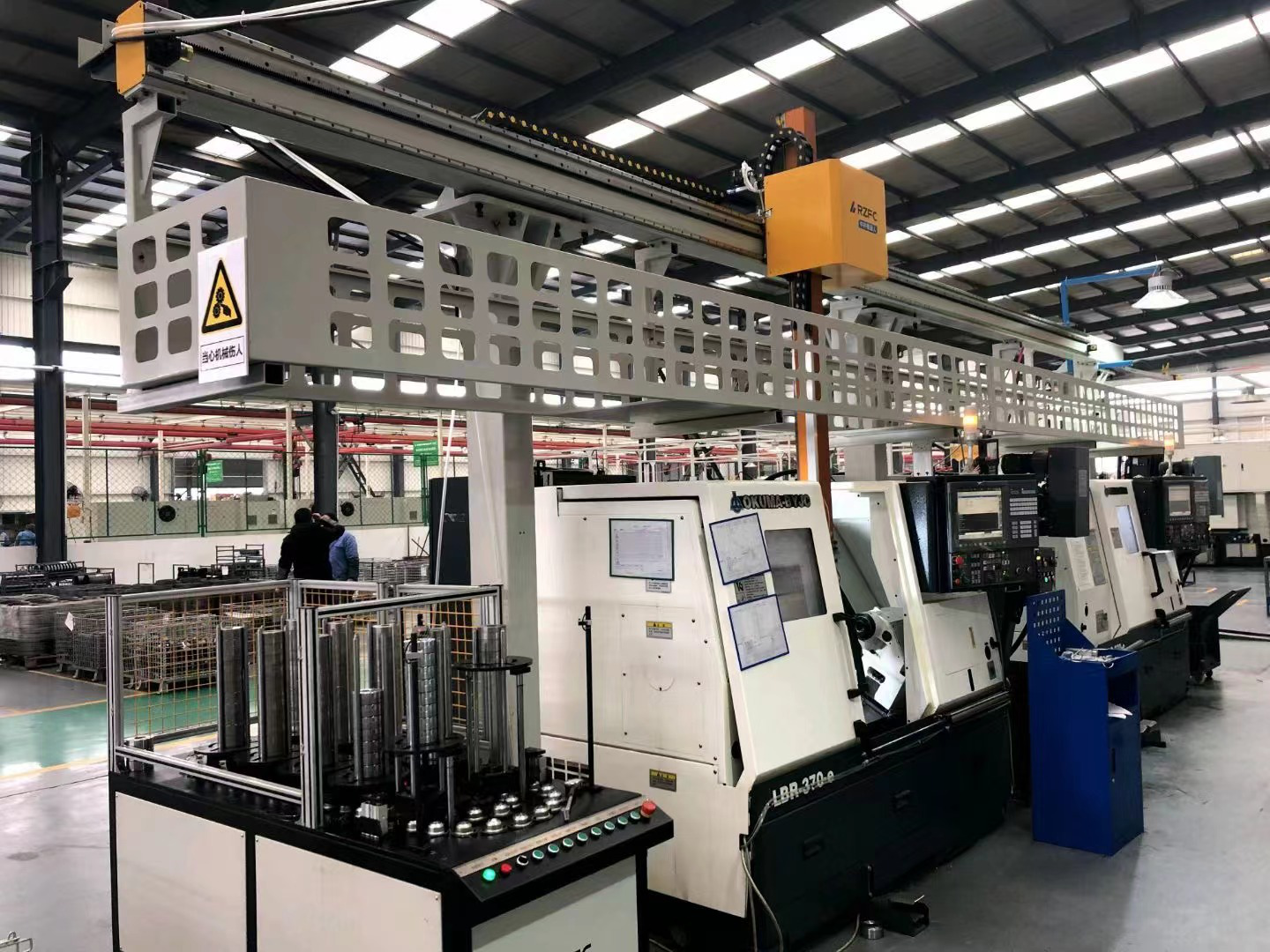
Selecting the Right Partner for Your 4 Axis Horizontal CNC Machining Center
Choosing a supplier for a 4 Axis Horizontal CNC Machining Center is as critical as the machine selection itself. A reliable partner ensures not only a quality product but also comprehensive support throughout its lifecycle. As an ISO9001:2015 certified manufacturer established in 2016, MAKCNC operates multiple production lines and maintains a stock of sample machines, allowing us to meet diverse manufacturing needs efficiently.
Our commitment to client success is reflected in our flexible commercial terms. While there is no rigid minimum order quantity, and even a single unit can be purchased, clients opting for bulk purchases (e.g., multiple machines) can benefit from more favorable business terms regarding price, delivery schedules, and after-sales service. Typical lead times range from 1 to 6 months.
We provide a standard warranty of 12 months after machine acceptance, with lifetime paid service available. For specific tender projects, we can offer extended warranty periods, such as three years of free warranty, where required. Our established after-sales network is designed for rapid response, typically promising a response within 8 hours and on-site fault resolution within 48 hours, minimizing downtime for our customers. To learn more
about makcnc and our commitment to quality, we invite you to explore our company profile.
Key Considerations Before Investing in a 4 Axis HMC
Before finalizing the investment in a 4 Axis Horizontal CNC Machining Center, consider these crucial points to ensure the machine aligns perfectly with your production strategy:
* **Part Geometry and Production Volume:** Assess if your typical parts genuinely benefit from multi-sided machining in a single setup. Does your production volume justify the higher initial investment over a VMC?
* **Fixture Design and Cost:** Evaluate the complexity and cost of fixtures required. HMCs can simplify fixturing for complex parts, but initial fixture design might require more engineering.
* **Tooling Requirements:** Consider the tool magazine capacity needed for your range of operations. HMCs often handle more complex tooling needs due to multi-face machining.
* **Floor Space and Automation Potential:** An HMC often provides higher output per square foot. Also, consider its compatibility with automation systems like pallet pools or robotics for lights-out manufacturing.
* **Operator Skill Set:** While HMCs can reduce manual intervention, programming and operating these machines effectively often requires a higher skill level.
* **Maintenance and Support:** Understand the supplier's warranty, service network, and spare parts availability. Rapid response times, like MAKCNC's 8-hour response and 48-hour on-site service, are critical for minimizing production interruptions.
* **Future Production Needs:** Will the HMC's capabilities support your projected growth or diversification into new product lines? Its versatility might open up opportunities for new contracts.
Frequently Asked Questions About 4 Axis HMCs
What is the primary difference between a 3-axis VMC and a 4-axis HMC?
A 3-axis Vertical Machining Center (VMC) primarily machines parts from the top, front, or side, requiring manual re-fixturing to access other faces. A 4-axis Horizontal Machining Center (HMC) has a horizontally oriented spindle and typically includes a rotary table (the 4th axis), allowing for automatic indexing and machining of multiple part faces in a single setup without manual intervention.
Can a 4-axis HMC perform operations typically done on a CNC lathe?
While some HMCs have advanced capabilities, they are primarily milling machines. For dedicated turning operations, a
cnc lathing machine would be the appropriate choice. However, some HMCs can perform light turning-like operations on stationary workpieces using rotating tools, but this is not their core function.
How does a 4-axis HMC improve part accuracy?
By performing multi-sided machining in a single clamping, a 4-axis HMC reduces the need for multiple setups. Each re-fixturing introduces potential for human error and datum shift, which can impact accuracy. Single-setup machining maintains consistent part orientation relative to the machine's coordinate system, leading to higher overall accuracy and repeatability.
What kind of parts are best suited for 4-axis HMC production?
Parts requiring machining on multiple sides, such as valve bodies, manifold blocks, gearboxes, engine components, and complex molds, are ideal for 4-axis HMCs. Their efficiency scales with part complexity and production volume.
What is the typical lifespan of a well-maintained 4-axis HMC?
With proper maintenance, a high-quality 4-axis HMC built with robust materials like high-strength cast iron and precision components can have an operational lifespan exceeding 15-20 years. Regular preventative maintenance, consistent lubrication, and adherence to manufacturer guidelines are essential for maximizing machine longevity.
The investment in a 4 Axis Horizontal CNC Machining Center is a strategic move that, when correctly evaluated against production needs and long-term cost savings, can significantly enhance manufacturing capabilities and competitiveness. We at makcnc are ready to assist you in making an informed decision.
If you are evaluating suppliers for a 4 Axis Horizontal CNC Machining Center, please contact us for a detailed consultation and to receive a tailored quotation.